
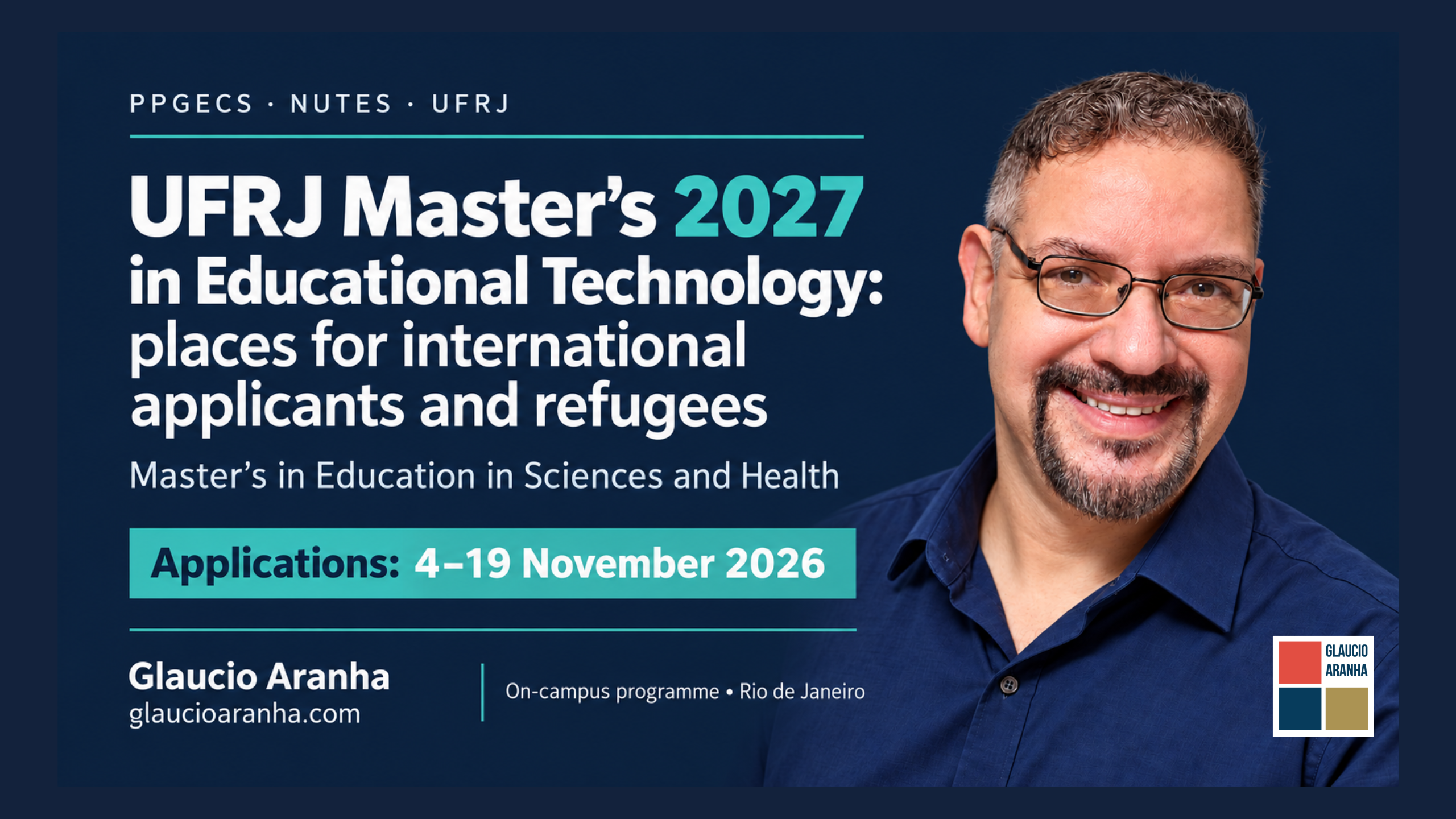
The Graduate Program in Science and Health Education (PPGECS) at the NUTES Institute, Federal University of Rio de Janeiro (UFRJ), is accepting applications for its 2027 Master’s cohort from 4 to 19 November 2026. Of the 29 places available, one is reserved for a foreign national living outside Brazil and one for a refugee, under the university’s affirmative action policy. I supervise in the program’s Educational Technology in Science and Health research line, and I share this call because both reserved places are easily overlooked by applicants unfamiliar with Brazilian graduate admissions.
Selection does not require travel to Brazil. Applications are sent by e-mail (proseletivo.ppgecs@gmail.com), with each document as a separate PDF, including a research pre-project of up to ten pages and a reflective academic memoir of up to seven; foreign applicants use their passport identification pages and an undergraduate diploma recognized by the issuing country’s authorities or apostilled. After the assessment of the pre-project, applicants defend it, together with the memoir, in an online oral examination held on 14–18 December 2026. The program itself, however, is fully in person at UFRJ’s Ilha do Fundão campus in Rio de Janeiro, with at least 20 hours of weekly commitment, and all stages assess command of Portuguese, so applicants should be able to write and discuss their research in Portuguese. An English reading proficiency certificate is required but may be submitted until 9 July 2027. Scholarships are awarded through a separate selection after enrollment, subject to funding. Refugee applicants select that option on the form and sign the self-declaration (Annex 2, with their passport number); supporting documents follow Resolution CEPG/UFRJ nº 500/2026, and I recommend confirming the requirements with the program office.
My supervision, carried out in the CLASS research group (Cognition, Language and Audiovisual in Semiotic Systems), which I lead, understands educational technology broadly, encompassing media, languages, representations and the imaginaries they produce. I welcome projects on topics such as:
- audiovisual media, images and narratives in science and health education;
- telehealth and video-based simulation in health care and professional training;
- digital games and simulation as ways of modelling scientific knowledge;
- semiotics of culture and meaning-making in scientific culture;
- technoscientific imaginaries in education and public health communication;
- epistemological, historical and philosophical questions of science in teaching and science communication;
- neuroeducation, neuromyths and the relations between representation and learning;
- science museums, including virtual ones, science communication and non-formal education;
- digital technologies, artificial intelligence and meaning-making;
- spirituality and subjectivity in science communication and health education.
Questions about this selection process should be addressed exclusively to the program office (proseletivo.ppgecs@gmail.com), while questions about my research lines, available places and supervision profile may be sent directly to me (glaucioaranha@ufrj.br). Naming a prospective supervisor is optional and does not imply prior acceptance, and letters of acceptance or recommendation are not allowed; to assess possible dialogue with ongoing research, I recommend consulting my Lattes CV (http://lattes.cnpq.br/1047823602449101) and the CLASS group page (https://glaucioaranha.com/class/).
Key dates: applications 4–19 November 2026, until 11:59 pm on the last day (Brasília time, UTC−3); pre-project results 2 December; online oral defenses 14–18 December; final results 26 February 2027. Full call (in Portuguese, the official version, which prevails over this summary): https://www.nutes.ufrj.br/2026/10/21/processo-seletivo-mestrado-academico-2027/.
Deixe um comentário