
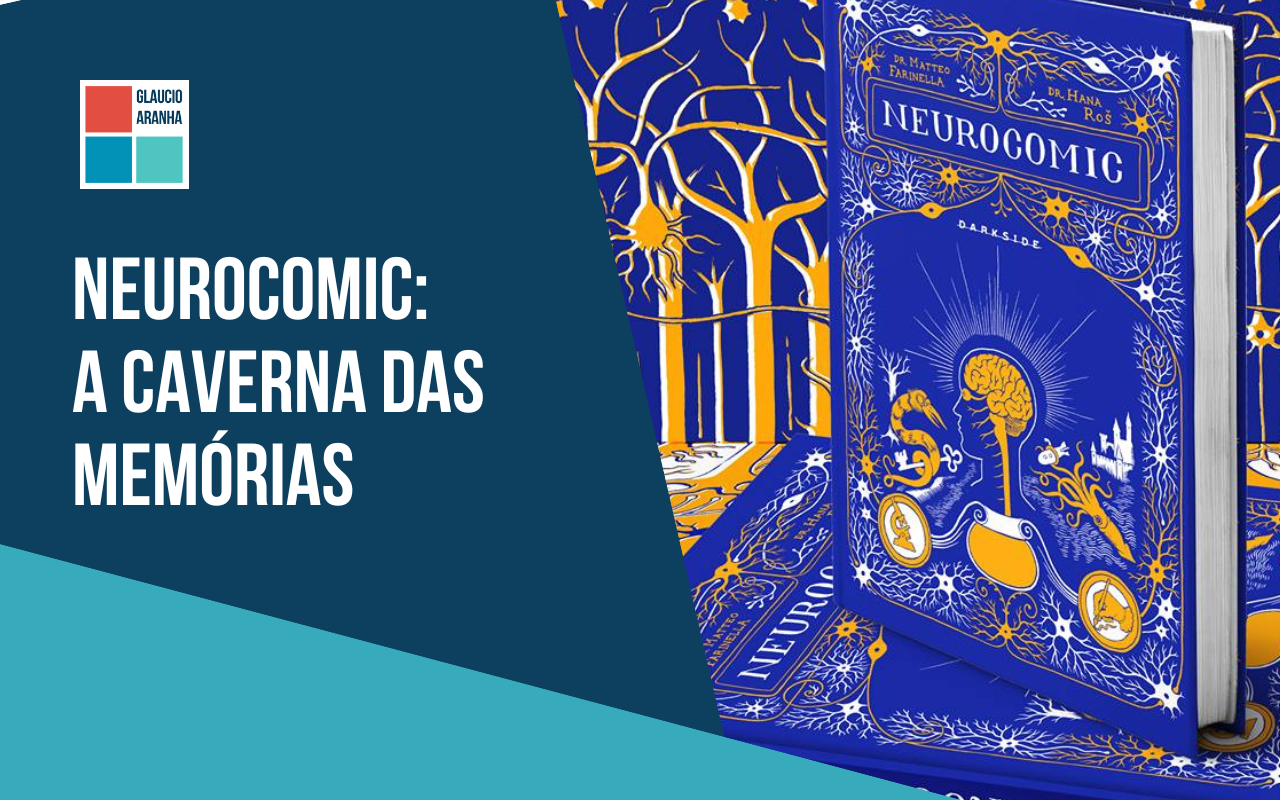
Neurocomic is a comic book written by neuroscientists Hana Roš and Matteo Farinella to explain the basic principles of how the brain works to lay readers in a very accessible way. Whether the venture succeeds depends a lot on how you look at it. As a fan and student of comics and their language, I confess I was very dissatisfied with the final result. Why? Simple. When you try to use a medium for teaching purposes, you risk excessive didacticism, focusing on content as if it were a lesson, to the point of falling well short of the technique, language and format expected of that medium.
By comparison, take a fan of Brazilian prime-time soap operas following the saga of a character, say a manicurist named Josefina who is being harassed by her neighbour and is in love with Felinto, the postman. If Josefina spent ten minutes of an episode talking to the camera about poor transport conditions in the outskirts, because the topic mattered to the author of this hypothetical soap, would the episode work? Obviously not, because viewers want to see Josefina’s story unfold (the narrative) and have not sat down for a lesson on the sociopolitical issues of urban transport. Nothing prevents important topics of all kinds from being brought into all kinds of media, but the language and compositional technique of the chosen medium must be respected if one really wants to reach the intended audience.
That is precisely the problem with Neurocomic. The comic does not present itself as a textbook in comic form but as a comic narrative related to neuroscience. In that case, the universe of expectations is very different. In the first case, the reader knows they are getting a “lesson” that uses comic elements, and in that sense it would have succeeded; but the text was presented in the second way, and a comics reader certainly does not expect a “lesson” disguised as sequential panels. The idea is good, but it falls into excessive pedagogism, which impoverishes the experience of the comics language.
Returning to the question in the first paragraph: yes, the text does convey some veeery basic and veeery superficial neuroscience principles to lay readers, but it creates a story that, in my case, I kept reading to the end only out of the stubbornness of a comics reader who hoped (in vain) that the text would improve as a comic. It did not. In the end, it seemed more useful in isolated moments, that is, single pages work for science communication, more like cartoons than comics. What is the difference? Sequencing. A cartoon is usually a single image or a very quick transition between two or three images. Comics, as the form is known in Brazil, involve a larger number of sequential panels developing an argument (a very brief explanation, just for lay readers). So Neurocomic‘s proposal of combining neuroscience teaching and comics works on isolated pages or panels, the logic of the cartoon, but not as a sequential narrative of the comic-book kind.
The art is interesting and I find it good, but not very captivating. It does not offer an experience that makes a comics reader feel they have found something new and stimulating aesthetically. As illustrative material for a class it can work, as long as the teacher makes clear that the drawings are rough schemes, not faithful to real cells, tissues and so on.
The binding is well made, hardcover, with embossed details that make the volume pleasant to handle. I must confess the finish was, for me, the high point of this volume, which is no surprise, since Darkside produces collector’s editions whose finish adds a lot of value to the work, sometimes even more than the work itself.
Deixe um comentário