
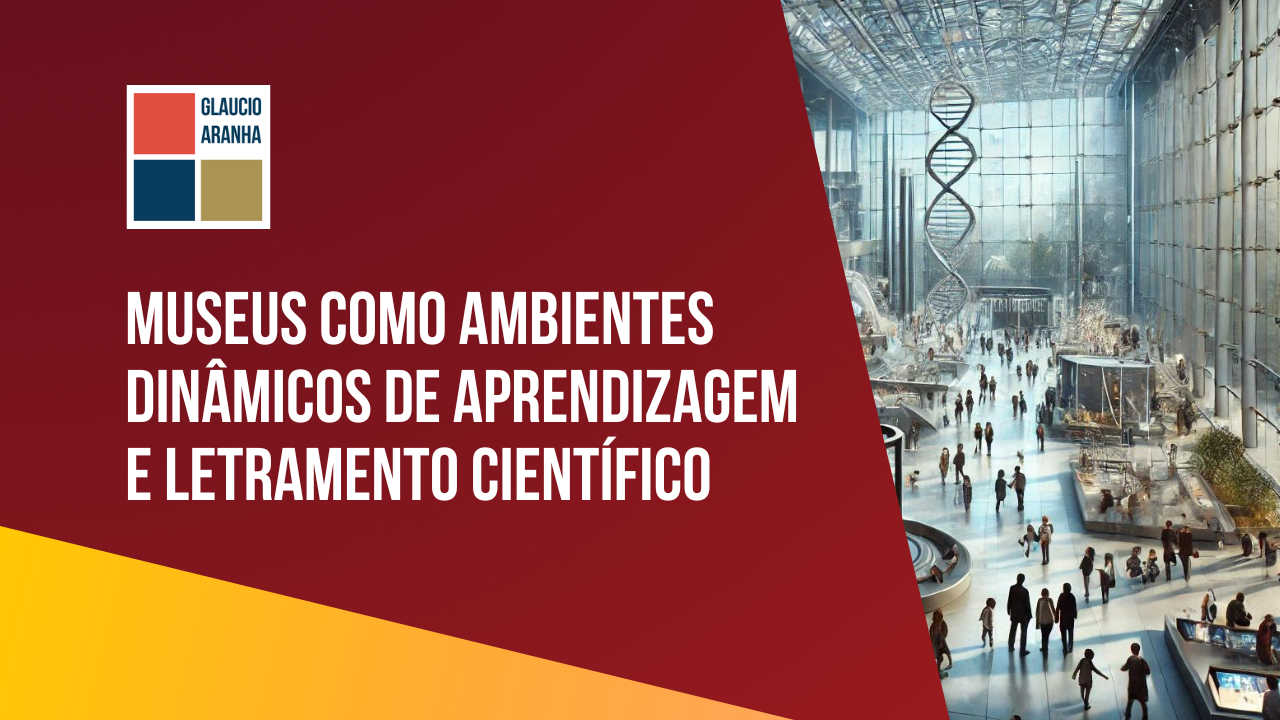
Science museums and museum spaces play a role in promoting science education and disseminating knowledge informally. These educational spaces go beyond exhibition areas, becoming dynamic environments that encourage curiosity, exploration and active learning.
Such institutions offer a very rich experiential approach to learning, as discussed by Hein (1998) in “Learning in the Museum”. Hein argues that these spaces foster constructivist learning, in which visitors build knowledge from their interactions with exhibits and activities. Constructivist theory, as developed by Piaget (1970) and Vygotsky (1978), emphasizes active learning and the construction of knowledge from individual and social experiences, elements that are central to the structure of science museums.
Falk and Dierking (2000), in “Learning from Museums: Visitor Experiences and the Making of Meaning”, point out that museum learning is shaped by personal, sociocultural and physical factors that interact to create a unique educational experience. They introduce the “Contextual Model of Learning”, which suggests that learning is a continuous process, not limited to the time of the visit but influenced by visitors’ previous and subsequent experiences. This perspective broadens our understanding of the educational impact of science museums, emphasizing the need to consider the wider context of learning.
The integration of digital technologies in science museums has further enhanced their educational role. As discussed by Tallon and Walker (2008) in “Digital Technologies and the Museum Experience: Handheld Guides and Other Media”, the use of mobile devices, augmented reality and other digital resources has enriched visitors’ experiences, making learning more interactive and personalized. Technology allows museums to reach broader and more diverse audiences and offers new ways of engaging with scientific content.
An interesting aspect of science museums and museum spaces is their capacity to promote scientific literacy. According to Duranti and Goodwin (1992), in “Rethinking Context: Language as an Interactive Phenomenon”, scientific literacy involves knowledge of scientific concepts and the ability to apply that knowledge in everyday contexts. In this sense, these institutions foster scientific literacy by offering experiences that connect science to the real world, helping visitors understand and apply scientific principles in their daily lives.
Another important dimension is their dialogue with formal education, in which they play a complementary role. According to research by Griffin and Symington (1997) in “Moving from Task-Oriented to Learning-Oriented Strategies on School Excursions to Museums”, school visits to museums can reinforce and expand concepts learned in the classroom. However, to maximize the educational impact of these visits, there must be planned integration between museum activities and the school curriculum. Collaboration between school educators and museum professionals is essential to create cohesive and meaningful learning experiences.
This reflection on the role of science museums in learning also leads us to consider the challenges these spaces face. Financial sustainability, the continuous updating of exhibitions and the need to include diverse and inclusive perspectives are issues that require constant attention. Janes (2010), in “Museums in a Troubled World”, stresses the importance of museums adapting to social and technological change, remaining relevant and accessible to increasingly diverse audiences.
As they face contemporary challenges, science museums must keep evolving, ensuring that they remain fundamental pillars of science education and knowledge dissemination. Brazil currently has important science museums and museum spaces, such as:
The main science museums and science museum spaces in Brazil include the following:
- PUCRS Museum of Science and Technology – Located in Porto Alegre, RS, it holds one of the largest permanent collections in Brazil, with around 5 million items. It covers topics such as archaeology, evolution and aquatic mammals, and offers interactive activities such as an electrostatics show and a planetarium.
- Address: Av. Ipiranga, 6681 – Partenon, Porto Alegre – RS
- Official website
- Museum of Tomorrow (Museu do Amanhã) – Opened in 2015 in Rio de Janeiro, this futuristic museum explores questions about the future of humanity and the planet, with interactive exhibitions on biodiversity, technology and climate.
- Address: Praça Mauá, 1 – Centro, Rio de Janeiro – RJ
- Official website
- Catavento Museum – Located in São Paulo, SP, it is an interactive museum covering themes such as the universe, life, ingenuity and society, with many installations and hands-on activities.
- Address: Av. Mercúrio, Parque Dom Pedro II, s/n – Brás, São Paulo – SP
- Official website
- Emílio Goeldi Museum of Pará – Located in Belém, PA, it is one of the oldest museums in Brazil, with a vast collection on the biological and sociocultural diversity of the Amazon.
- Address: Av. Magalhães Barata, 376 – São Brás, Belém – PA
- Official website
- Museum of Life (Museu da Vida) – Part of the Oswaldo Cruz Foundation (Fiocruz) in Rio de Janeiro, RJ, this museum combines science, culture and health, with several interactive installations and the “science train”.
- Address: Av. Brasil, 4365 – Manguinhos, Rio de Janeiro – RJ
- Official website
- Museum of Mines and Metal (Museu das Minas e do Metal) – Located in Belo Horizonte, MG, it is part of the Praça da Liberdade Cultural Circuit and offers an interactive approach to mining and metallurgy.
- Address: Praça da Liberdade, s/nº – Funcionários, Belo Horizonte – MG
- Official website
These museums are some examples, among many other important ones, of spaces dedicated to science education in Brazil, offering interactive and educational experiences that contribute to the dissemination of knowledge and the promotion of scientific literacy.
References
DURANTI, A.; GOODWIN, C. Rethinking Context: Language as an Interactive Phenomenon. Cambridge: Cambridge University Press, 1992.
FALK, J. H.; DIERKING, L. D. Learning from Museums: Visitor Experiences and the Making of Meaning. Walnut Creek: AltaMira Press, 2000.
GRIFFIN, J.; SYMINGTON, D. Moving from Task-Oriented to Learning-Oriented Strategies on School Excursions to Museums. Science Education, v. 81, n. 6, p. 763-779, 1997.
HEIN, G. E. Learning in the Museum. London: Routledge, 1998.
JANES, R. R. Museums in a Troubled World: Renewal, Irrelevance or Collapse?. London: Routledge, 2010.
PIAGET, J. Science of Education and the Psychology of the Child. New York: Orion Press, 1970.
TALLON, L.; WALKER, K. Digital Technologies and the Museum Experience: Handheld Guides and Other Media. Lanham: AltaMira Press, 2008.
VYGOTSKY, L. S. Mind in Society: The Development of Higher Psychological Processes. Cambridge: Harvard University Press, 1978.
Deixe um comentário