
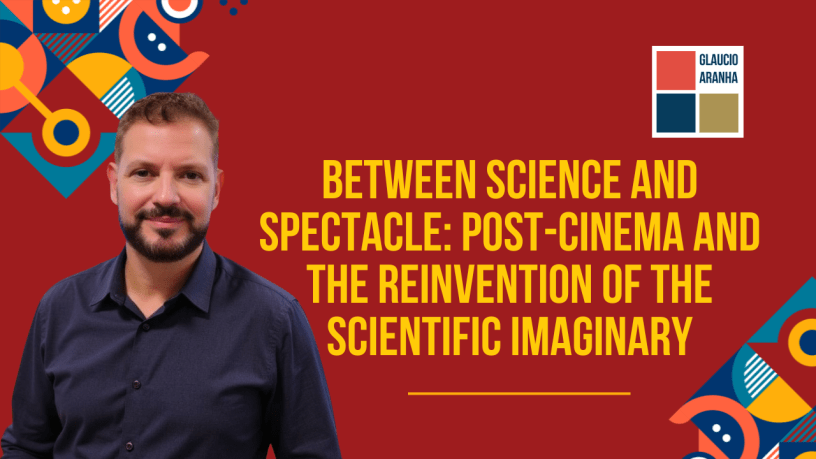
My new article, “Between Science and Spectacle: Post-Cinema and the Reinvention of the Scientific Imaginary” (currently available only in Portuguese, in english sooner) published in the journal Ética & Filosofia Política, starts from a simple yet unsettling premise: nowadays, most people encounter science in short videos, memes, and live streams, rather than in the pages of a book or in classrooms. This digital audiovisual environment —commonly called post-cinema — encompasses the entire digital audiovisual ecosystem, from reels to virtual-reality experiences, and radically reshapes the way we think about, feel, and place our trust in scientific knowledge. In post-cinema, information travels in compressed form, yet is wrapped in visual effects and emotional appeals; thus, what was once presented as argument comes to be perceived as spectacle.
To grasp what is at stake, I turn to two thinkers whose ideas converse fluidly with one another. Juri Lotman describes culture as a vast semiosphere: a living space where different sign systems intersect, negotiate meaning, and sometimes collide. At the core of this sphere lie the most highly codified discourses — among them, academic science — while on its margins ideas circulate more freely, acquiring new hues, metaphors, and interests. It is precisely along these edges, energized by digital platforms, that the sign “Science” becomes at once more accessible and more vulnerable to distortion. Friedrich Nietzsche, for his part, reminded us that all knowledge is historical and perspectival — a construction permeated by human values (perspectives). When science relinquishes its aura of neutrality and enters the realm of likes and shares, it becomes evident just how much it depends on the languages and interests that clothe it.
In this landscape two emblematic figures emerge: the post-scientist and the post-specialist. The post-scientist retains academic credentials but speaks like an influencer, condensing complex theories into one-minute videos, melding rigor with charisma, and often sacrificing depth for visibility. The post-specialist, in turn, is a kind of mediator without a fixed discipline, adept at platform logic, weaving data from different fields, and presenting himself as a curator of “everything you need to know.” Both broaden the reach of science, yet they also subject it to the logic of instant attention.
The issue lies not only in media popularization aimed at financial or symbolic profit, but in the risk that a compressed narrative will replace the very experience of comprehension. When a complex scientific concept becomes a hyper-real set of seductive images — in Baudrillard’s term — the method, the doubt, and the context disappear from view. The public receives the feeling of understanding, not understanding itself. Such dilution creates room for both healthy curiosity and conspiracy theories. After all, the same video-platform algorithm that offers a brilliant documentary on black holes can immediately recommend a clip defending the flat-Earth theory.
Even so, post-cinema is not an enemy to be fought, but a stage on which science must learn to perform anew. If we recognize that the message changes when the medium changes, we can craft audiovisual formats that preserve complexity without sacrificing narrative allure. This demands a media literacy that combines aesthetic sensitivity with critical thinking, shaping viewers who can enjoy the beauty of the spectacle without abandoning a commitment to verification and informed public debate. In this way, science goes on reinventing itself — not as absolute truth, but as a plural, open conversation that remains, above all, essential for guiding our collective choices.
The full article can be accessed at: https://periodicos.ufjf.br/index.php/eticaefilosofia/article/view/47106 (currently available only in Portuguese).
Reference:
ARANHA, Glaucio. Entre a ciência e o espetáculo: o pós-cinema e a reinvenção do imaginário científico. Ética e Filosofia Política, v. 1, n. 28, pp. 29-50, 2025. Disponível em https://periodicos.ufjf.br/index.php/eticaefilosofia/article/view/47106
Descubra mais sobre Glaucio Aranha
Assine para receber nossas notícias mais recentes por e-mail.
 Glaucio Aranha