
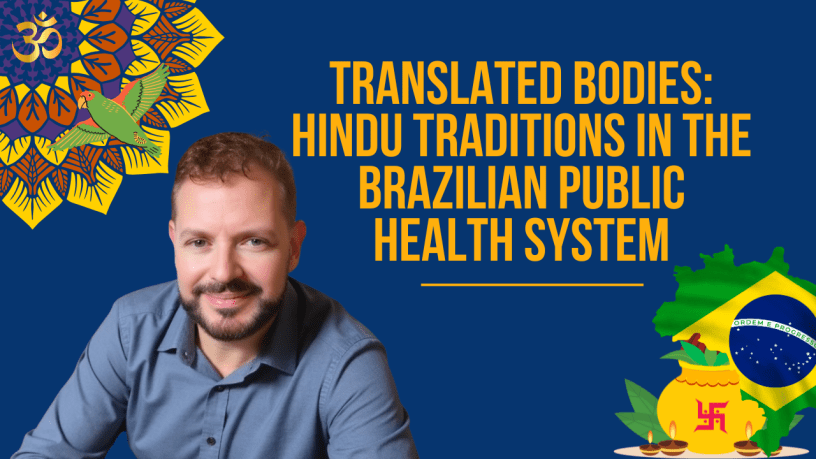
On a humid Wednesday morning in Curitiba (Paraná, Brazil), a group of patients gathers in the courtyard of a Family Health Unit (Brazilian government health facilities). Before their medical consultations, they are invited to practice a few minutes of conscious breathing (prāṇāyāma) and gentle stretching movements inspired by sūrya-namaskār, a traditional Yoga sequence. Then, they take part in a conversation about balanced nutrition based on the principles of Āyurveda, an ancient Indian system of medicine.
Scenes like this, now observed in some teams of Brazil’s Unified Health System (SUS), would have been unthinkable two decades ago. This change began in 2006, when the Brazilian Ministry of Health established the National Policy on Integrative and Complementary Practices in Health (Política Nacional de Práticas Integrativas e Complementares em Saúde – PNPIC), which officially recognized therapies such as acupuncture, herbal medicine, and homeopathy (Brasil, 2006). In 2017, this policy was expanded through Ordinance No. 849, which included Yoga and Āyurveda among the practices available within SUS — two systems of care deeply rooted in Indian culture (Brasil, 2017).
In this article, I examine the potential that the articulation of these Hindu traditions and principles may bring to the Brazilian public health system and its current health policy. More than a matter of intercultural curiosity, this convergence represents an encounter between distinct ways of understanding care: on one side, the Western biomedical rationality; on the other, the holistic view of the human being that characterizes Āyurvedic medicine and Yoga philosophy. The meeting point of these approaches lies in the domain of integrative practices, where concepts such as prakṛti — the individual psychophysical constitution which, according to Āyurveda, guides the balance between body and mind — begin to be translated into the context of Brazilian primary healthcare.
To understand how such distinct traditions can meet and engage in dialogue, it is useful to draw on an important concept from cultural semiotics: the semiosphere. Coined by the Russian semiotician Yuri Lotman, the term designates the symbolic space in which different languages, cultures, and worldviews coexist and come into contact (Lotman, 1990). The idea is simple yet holds a certain complexity: every culture functions as an ecosystem of signs, and encounters between cultures generate symbolic border zones — intersections between semiospheres. These liminal spaces are porous, though by no means free of tension.
It is within this border space that Yoga and Āyurveda enter the field of Brazilian public health. When practices such as prāṇāyāma (breathing exercises) or dinacaryā (daily Āyurvedic routines) are incorporated into the activities of Family Health Units, they undergo a process of translation that is not merely linguistic, but also cultural, symbolic, and institutional. As researcher Lucia Santaella points out, such hybridity is intensified in today’s interconnected world, where media and technologies facilitate the global flow of knowledge and practices (Santaella, 2013).
It is worth underscoring that, in the encounter between Hindu health worldviews and conventional Western medicine, we face a challenge that entails re-signifying both the practices themselves and the agents involved (physician and patient). From the Lotmanian semiotic perspective (Lotman, 1990), the patient’s body is a “text” laden with meanings, experiences, and identities. Hence, when new cultural practices are introduced into treatment, the patient actively participates in constructing meaning between what Western allopathic medicine prescribes and what practices such as Yoga or Āyurveda propose. The patient thus becomes a co-author of care, for they will not passively accept these new practices. Rather, they enter a border zone of meaning production in which they articulate their memories, their perceptions of illness and care, and their psychological openness to dialogue with elements from another culture. This is a movement rich in signification — a process of co-constructing care that cannot simply be imported wholesale.
This brings us, then, to a broader debate over what “health” actually signifies. The French philosopher Jean-François Lyotard noted that, for decades, we have inhabited an era marked by mistrust toward grand universal narratives such as scientism or linear progress. In this setting, “language games” — that is, the diverse, situated ways of producing meaning — proliferate (Lyotard, 1984). Historical genealogies of health are continually re-read and re-signified as they circulate across cultures and form new meaning relations with varied sociocultural contexts, exponentially multiplying the micro-narratives surrounding the sign “health.” Every cultural system mobilizes languages specific to its milieu, which strongly shape how complementary treatment options are proposed and received. When distinct concepts of health — such as the Indian and the Brazilian — are brought into proximity, fresh challenges emerge for meaning-making within the sphere of care.
The PNPIC reflects this epistemological shift. By recognizing therapies originating in non-Western traditions — such as Chinese medicine, shamanic practices, and Āyurveda — Brazil’s Unified Health System (SUS) affirms the right to epistemic plurality. This policy represents a form of acknowledgment that knowledge produced by populations historically marginalized in the global arena also holds value, efficacy, and legitimacy (Santos; Meneses, 2010) and deserves to be heard and understood.
This plural gaze also dovetails with the approach of clinical anthropology, particularly in the work of Arthur Kleinman and Peter Benson, who argue that a health professional should not merely “understand the patient’s culture,” but rather reconstruct with the patient their narratives of suffering and care (Kleinman & Benson, 2006). In this vein, when an Ayurvedic physician identifies a patient as a vāta–pitta type, for example, an intricate articulation of languages and cultures is taking place. Recognising patterns of bodily and emotional sensitivity is not simply a matter of categorisation; it is a linguistic and cultural immersion that demands intercultural literacy and dialogue with new biomedical categories, lifestyles, and varied sociocultural perspectives.
Finally, it is important to recall that this movement is not confined to Brazil. The World Health Organization (WHO) has been encouraging its member states to integrate traditional medicines into their health-care systems, provided this is done safely and on an evidence-based foundation. The WHO’s new Global Traditional Medicine Strategy (2025–2034) reaffirms this commitment and underscores the importance of respecting the epistemologies inherent to each system of care (WHO, 2024).
Thus, the prospect of incorporating Hindu practices—such as Āyurveda and Yoga—into Brazil’s Unified Health System (SUS) is a political, epistemic, and cultural decision that redefines our understanding of health, care, and the common good. It is salutary that this dialogue be accompanied by the academic sphere so that new knowledge can be generated—preferably through bilateral collaborations, given the plurality of agents and forms of knowledge involved—and that public policies move beyond the mere formal legitimation of “exotic practices,” embedding mechanisms for ongoing evaluation, intercultural training of professionals, and active participation of user communities.
In this way, dialogue between the semiospheres of Western biomedicine and Hindu medical systems can foster concrete synergies, avoiding reductionist appropriations and, in an ethically responsible manner, expanding the therapeutic repertoire offered to the population. Ultimately, recognizing the coexistence of these different knowledge regimes means conceding that health care is an essentially dialogic and dynamic practice whose horizon of meaning widens when we are able to inhabit cultural borderlands with critical openness and public commitment.
References
Brasil. Ministério da Saúde. (2006). Portaria GM/MS nº 971, de 3 de maio de 2006. Institui a Política Nacional de Práticas Integrativas e Complementares no SUS. https://bvsms.saude.gov.br/bvs/saudelegis/gm/2006/prt0971_03_05_2006.html
Brasil. Ministério da Saúde. (2017). Portaria GM/MS nº 849, de 27 de março de 2017. Amplia as práticas integrativas e complementares no SUS. https://bvsms.saude.gov.br/bvs/saudelegis/gm/2017/prt0849_28_03_2017.html
Charaka. (1999). Charaka-Saṃhitā (Edição em sânscrito e inglês). Varanasi, Índia: Chaukhambha Orientalia.
Feuerstein, G. (2008). The Yoga Sūtra of Patañjali: A new translation and commentary. Rochester, VT: Inner Traditions.
Kleinman, A., & Benson, P. (2006). Anthropology in the clinic: The problem of cultural competency and how to fix it. PLoS Medicine, 3(10), e294. https://doi.org/10.1371/journal.pmed.0030294
Lotman, Y. M. (1990). Universe of the mind: A semiotic theory of culture (A. Shukman, Trans.; U. Eco, Ed.). Bloomington: Indiana University Press.
Lyotard, J.-F. (2009). A condição pós-moderna: Um relatório sobre o saber (R. Barbosa & M. B. N. da Silva, Trans.). São Paulo: José Olympio. (Original work published 1979)
Santaella, L. (2013). Cultura e artes do pós-humano: Da cultura das mídias à cibercultura. São Paulo: Paulus.
Santos, B. de S., & Meneses, M. P. (Eds.). (2010). Epistemologias do Sul. Coimbra, Portugal: Almedina.
World Health Organization. (2024). WHO traditional medicine strategy 2025–2034 (Draft). https://cdn.who.int/media/docs/default-source/tci/draft-traditional-medicine-strategy-2025-2034.pdf?sfvrsn=dd350962_1
Descubra mais sobre Glaucio Aranha
Assine para receber nossas notícias mais recentes por e-mail.
 Glaucio Aranha