
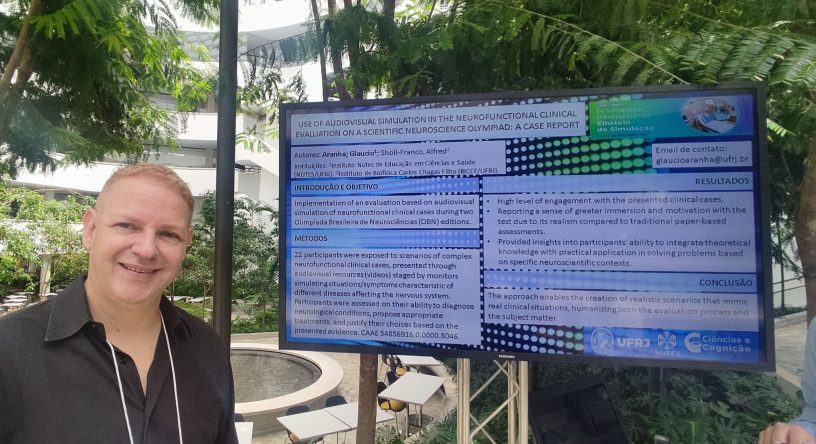
Hoje, pude apresentar no IV Simpósio Internacional Einstein de Simulação, o primeiro produto acadêmico de mais uma parceria com Alfred Sholl Franco. Trata-se de uma pesquisa envolvendo o Laboratório de Vídeo Educativo (LVE/Nutes/UFRJ) e o Núcleo de Divulgação Científica e Ensino de Neurociências (NUDCEN/IBCCF/UFRJ), com o apoio da Organização Ciências e Cognição (OCC). O trabalho “Use of audiovisual simulation in the neurofuncional clinical evaluation on a scientific neuroscience olympiad: a case report” dá o ponta pé inicial para essa pesquisa em Ensino Baseado em Evidência com foco na simulação.

USE OF AUDIOVISUAL SIMULATION IN THE NEUROFUNCTIONAL CLINICAL EVALUATION ON A SCIENTIFIC NEUROSCIENCE OLYMPIAD: A CASE REPORT
Glaucio Aranha1, Alfred Sholl-Franco2
1 Instituto Nutes de Educação em Ciência e Saúde, Universidade Federal do Rio de Janeiro, Rio de Janeiro, RJ, Brasil.
2 Instituto de Biofísica Carlos Chagas Filho, Universidade Federal do Rio de Janeiro, Rio de Janeiro, RJ, Brasil.
1 https://orcid.org/0000-0002-5792-5560
2 https://orcid.org/0000-0002-1951-0137
Formato de apresentação: exposição oral
Tema: Relato de experiência
Introduction: The assessment of scientific and cognitive competencies is essential for advancing the understanding of neuroscience and fostering students’ interest in this field1. In this context, audiovisual simulations of neurofunctional clinical cases emerge as an innovative approach2 in evaluating participants’ knowledge and skills in a scientific competition, such as the Olimpíada Brasileira de Neurociências – OBN (Brazilian Brain Bee – BBB). Methodology: This research describes the development and implementation of an evaluation based on audiovisual simulation3, 4 during two BBB editions. Participants (22) were exposed to scenarios of complex neurofunctional clinical cases, presented through audiovisual resources (videos) staged by monitors simulating situations/symptoms characteristic of different diseases affecting the nervous system. Participants were assessed on their ability to diagnose neurological conditions, propose appropriate treatments, and justify their choices based on the presented evidence. CAAE 54856916.0.0000.8046. Results: The introduction of audiovisual simulation as an evaluation method yielded promising results5, 6. Participants demonstrated a high level of engagement with the presented clinical cases, reporting a sense of greater immersion and engagement with the test due to its realism compared to traditional paper-based assessments. Furthermore, the evaluation provided insights into participants’ ability to integrate theoretical knowledge with practical application in solving problems based on specific neuroscientific contexts. Discussion: Audiovisual simulation offers a dynamic and interactive way to assess participants’ neuroscience knowledge. The approach enables the creation of realistic scenarios that mimic real clinical situations, humanizing both the evaluation process and the subject matter. It reveals the complexity of scenarios involving patient expressiveness (greater or lesser), challenging students to apply their knowledge practically, incorporating not only formal knowledge but also the observational skills necessary during patient history-taking. Additionally, simulation-based assessment4 can help identify gaps in participants’ understanding and guide improvements in the educational curriculum. Conclusion: This experiential report highlights the effectiveness of audiovisual simulation as an innovative assessment tool in the neurofunctional clinical stage of Brain Bee, extendable to competitions beyond the thematic scope of BNO. The approach provides an engaging and realistic way to evaluate students’ neuroscientific skills/knowledge, promoting a deeper and more applied understanding of the discipline. The continued integration of simulation methods can enrich learning and assessment in this field, preparing participants for future explorations in the realm of neuroscience.
Keywords: Education, Instructional Film and Video, Simulation
References:
1 Sharon MacLean, Fiona Geddes, Michelle Kelly, Phillip Della, Video Reflection in Discharge Communication Skills Training With Simulated Patients: A Qualitative Study of Nursing Students’ Perceptions, Clinical Simulation in Nursing, Volume 28, 2019, Pages 15-24, https://doi.org/10.1016/j.ecns.2018.12.006.
2 Manning, Phil R. M.D.1,a. Continuing education in the health sciences. Can we change the paradigm? Mobius: A Journal for Continuing Education Professionals in Health Sciences 2(2):p 5-7, April 1982. | DOI: 10.1002/chp.4760020203
3 Brimble, Mandy. “Skills assessment using video analysis in a simulated environment: an evaluation.” Nursing Children and Young People 20.7 (2008).
4 Brost, B.C. Thiemann, K.M.B., Dunn, W. Evaluating, Prioritising, and selecting simulators. (pp.201-205) In: Kile Jr., R., Murray, W.B. Clinical Simulation. Elsevier, 2008.
5 Issenberg SB, Scalese RJ. Simulation in health care education. Perspect Biol Med. 2008;51(1):31–46.
6 Sidi A, Baslanti TO, Gravenstein N, Lampotang S. Simulation-based assessment to evaluate cognitive performance in an anesthesiology residency program. J Grad Med Educ. 2014 Mar;6(1):85-92. doi: 10.4300/JGME-D-13-00230.1. PMID: 24701316; PMCID: PMC3963801.
Descubra mais sobre Glaucio Aranha
Assine para receber nossas notícias mais recentes por e-mail.
 Glaucio Aranha